Event carbon footprint
A trade fair, congress or festival doesn't emit like a company. Visitor travel, catering and temporary stands make up most of the footprint. We measure these items with the same auditable method as our corporate clients: explicit assumptions, cited sources.
What counts
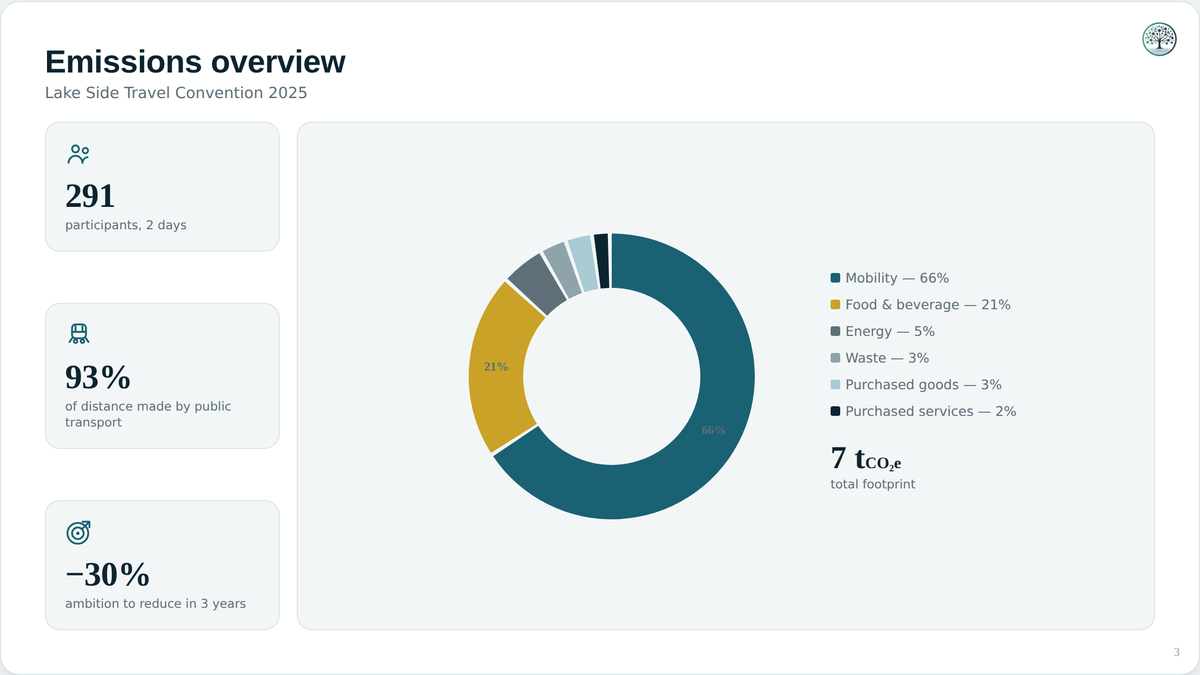
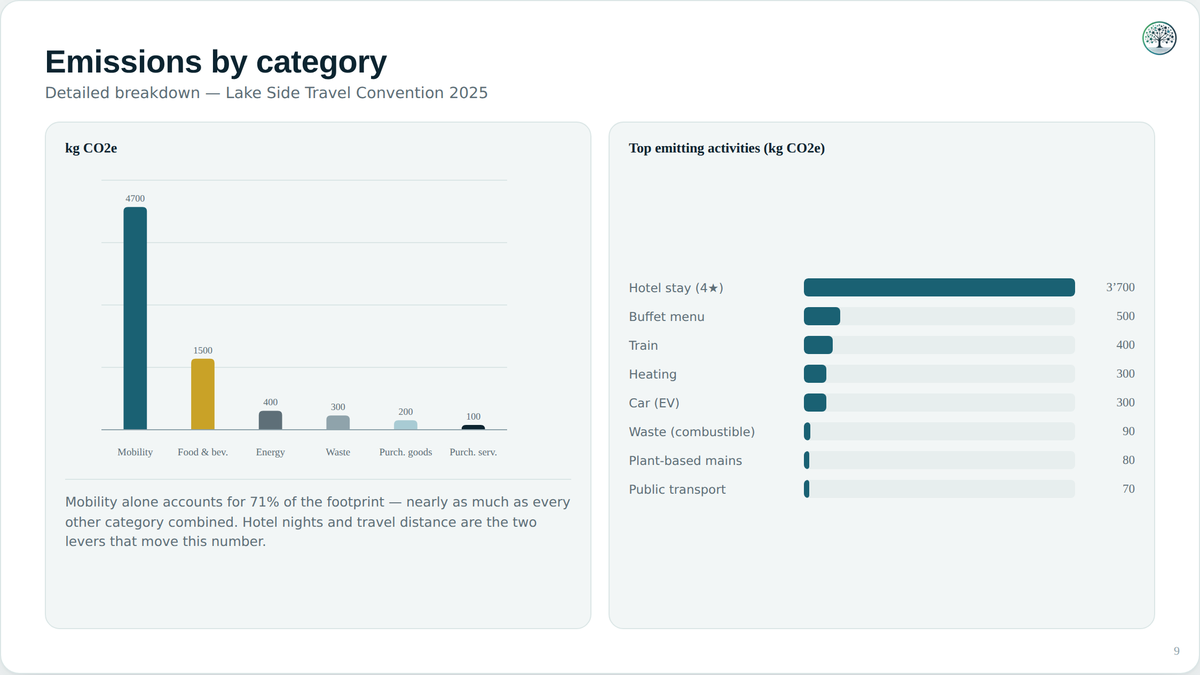
Visitor and exhibitor travel almost always dominates the total, often ahead of catering.
Visitor and exhibitor travel, usually the largest item.
Meals, drinks, food waste.
Materials, temporary structures, printing.
Electricity, heating, generators.
Volume generated, sorting, treatment.
How it works
You send us what you already have. We organise the rest.
Registration lists, supplier invoices, what you already have.
A simple link sent to your visitors, a few questions, a few minutes.
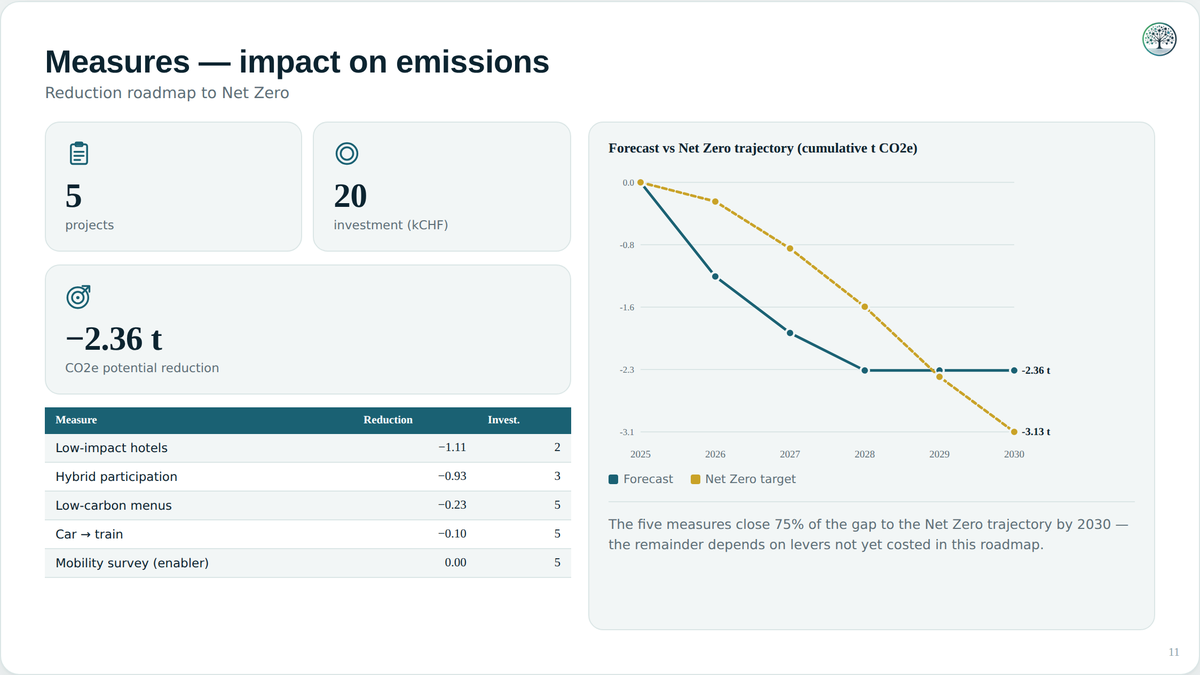
Total emissions, largest item, reduction pathway. You never open a spreadsheet.
Aperçu
Our method
No hidden assumption. Every figure is linked to its source and can be checked.
Tools such as eventkit.ch, backed by 16 Swiss cantons and the Federal Office for the Environment, check whether your event has produced a carbon footprint, ticked off among other sustainability criteria. We carry it out and hand you the figure.
Resources: Sustainable events checklist, EPFL · eventkit.ch
Frequently asked questions
No law requires it today. The pressure comes from elsewhere: cities and cantons that fund an event increasingly ask for a footprint and an action plan at renewal time, and sponsors and federations set the same requirement before committing. In practice, an event that wants to keep its funding needs the figure, even without a legal obligation.
Several weeks in advance. That lead time is for identifying the available data sources and putting good practices in place before the event, not reconstructing them afterwards.
No. A link, a few questions, a few minutes. We take care of the rest.
Let's talk
Three details are enough for a first conversation: the type of event, the expected number of participants, and whether it happens every year.
